The dofollow vs nofollow question comes up in almost every link building conversation, and it is often explained badly. In short, a nofollow link carries a signal that tells search engines not to treat the link as a normal endorsement, while a link without that signal is simply a normal link. This guide explains what each one does, what changed in recent years and how to decide which links deserve your time and budget.
Table of Contents
What Is a Dofollow Link?
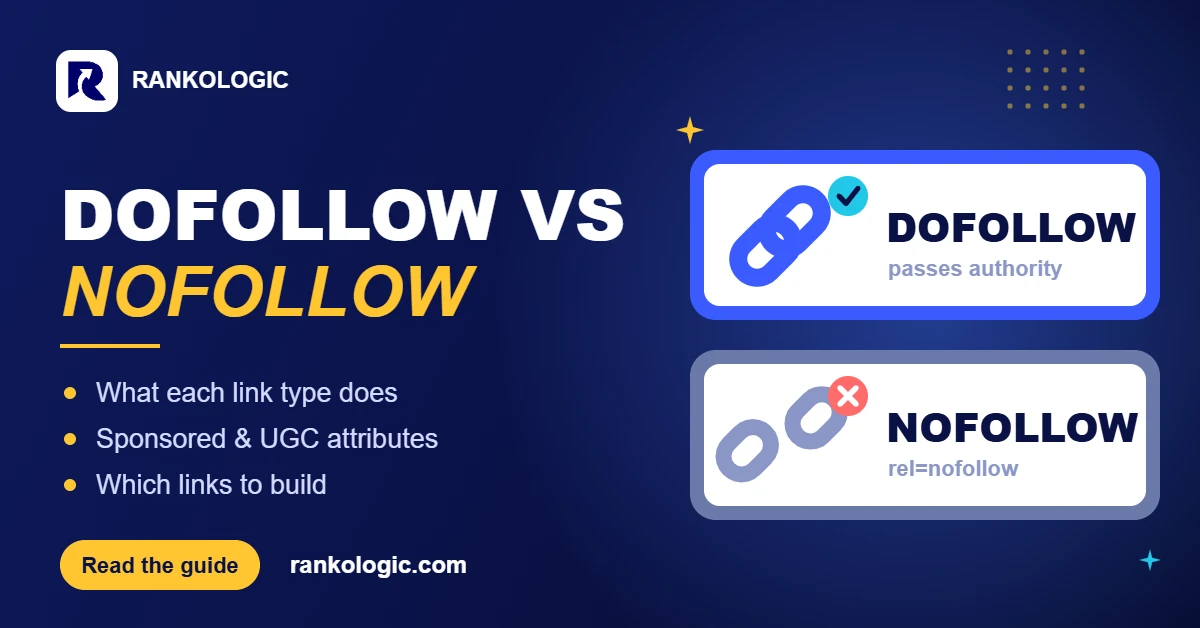
“Dofollow” is not an official attribute. It is a nickname for a standard link that has no rel attribute telling search engines to treat it differently. A normal link like this can pass ranking signals, often called link equity, from one page to another. When people say they want dofollow backlinks, they mean ordinary links that can help a page rank.
What Is a Nofollow Link?
A nofollow link carries the attribute rel=”nofollow”. It was introduced to fight comment spam and tells search engines the site owner does not want to vouch for the destination. For years Google treated it as a strict instruction not to follow the link. That changed in 2019, when Google began treating nofollow as a hint rather than a command, and from March 2020 it started using these hints for crawling and indexing too.
Sponsored and UGC Attributes
Google added two more attributes alongside nofollow so site owners can describe a link more precisely:
- rel=”sponsored” for paid placements, advertisements and affiliate-style links.
- rel=”ugc” for links inside user-generated content such as forum posts and comments.
- rel=”nofollow” as the general-purpose option when you do not want to endorse a link.
You can read Google’s own explanation in its guide to qualifying outbound links. The practical point is simple: the right attribute depends on why the link exists.
Dofollow vs Nofollow: The Key Differences
- Ranking value: dofollow links can pass authority. Nofollow links are treated as hints, so their direct ranking value is usually small or none.
- Typical sources: editorial articles and resource pages tend to be dofollow. Comments, forums, social posts and many ads are nofollow, ugc or sponsored.
- Discovery: even nofollow links can help people and crawlers find your page, and they can bring real visitors.
- Risk: a profile made of only dofollow links with exact-match anchors looks unnatural. Healthy profiles contain a mix.
Are Nofollow Links Worthless?
No. A nofollow link from a respected news site or a busy community can send qualified traffic, build brand awareness and lead to later mentions that are followed. Links also act as a trust signal for readers, not only for search engines. A natural backlink profile includes many nofollow links, so chasing only dofollow links is a mistake.
Which Should You Build: Dofollow vs Nofollow?
Aim for relevance first. A relevant link on a real, trafficked page is worth more than a dofollow link on a site nobody reads. In practice:
- Prioritise relevant editorial links, whether from guest posts or link insertions.
- Accept nofollow links from strong, relevant sites because of the traffic and trust they bring.
- Vary your anchor text. Our guide to anchor text strategy explains how.
- Judge sites by real traffic and quality, as covered in how to choose guest posting sites.
How to Check If a Link Is Dofollow or Nofollow
- Open the page and right-click the link, then choose Inspect.
- Look at the link’s HTML for a rel attribute containing nofollow, sponsored or ugc.
- If there is no such attribute, the link is a normal followed link.
- For many links at once, use an SEO crawler or a backlink checker that reports link attributes.
Paid Links and Google’s Rules
Google’s guidance is that links created in exchange for money should be qualified with sponsored or nofollow, and link schemes meant to manipulate rankings fall under its link spam policies. Many publishers handle this differently, so always agree link terms in advance, focus on quality and relevance, and keep your profile varied.
Common Dofollow vs Nofollow Myths
- “Nofollow links are useless.” They can still drive traffic, support brand awareness and appear in a natural profile.
- “Every dofollow link helps.” A followed link from an irrelevant or low quality page may do nothing, and a pile of them can look manipulative.
- “More dofollow links always means higher rankings.” Relevance, page quality and anchor variety matter as much as the attribute.
- “You can tell link value from the attribute alone.” The page, the site and the context decide value, not a single line of HTML.
What a Healthy Link Profile Looks Like
A natural backlink profile is a mix. It includes editorial followed links from articles, nofollow links from directories, social profiles and comments, some sponsored or ugc links, and a range of anchors from brand names to plain URLs. When you review your own profile, look for balance and relevance rather than a target ratio. If almost every link is an exact-match anchor from a similar kind of site, that is the pattern to fix, whichever side of the dofollow vs nofollow split it falls on.
Review it every few months: export your referring domains, mark the ones that bring traffic, and note which pages they point to. Pages with no links often need a guest post or a link insertion, while pages with too many identical anchors need variation.
FAQs About Dofollow vs Nofollow
Does nofollow help SEO at all?
Directly, only a little, because Google treats it as a hint. Indirectly it can help through traffic, brand exposure and later followed mentions.
Should my backlink profile be 100 percent dofollow?
No. A natural profile mixes followed and nofollow links. A perfectly dofollow profile can look manufactured.
Is sponsored the same as nofollow?
They are separate attributes. Sponsored specifically marks paid or commercial links, while nofollow is the general option.
Final Thoughts on Dofollow vs Nofollow
The dofollow vs nofollow debate matters less than the quality of the page the link sits on. Build relevant links, mix your link types, and measure results by traffic and rankings, not by attribute alone. If you want help building a balanced backlink profile, talk to our team.