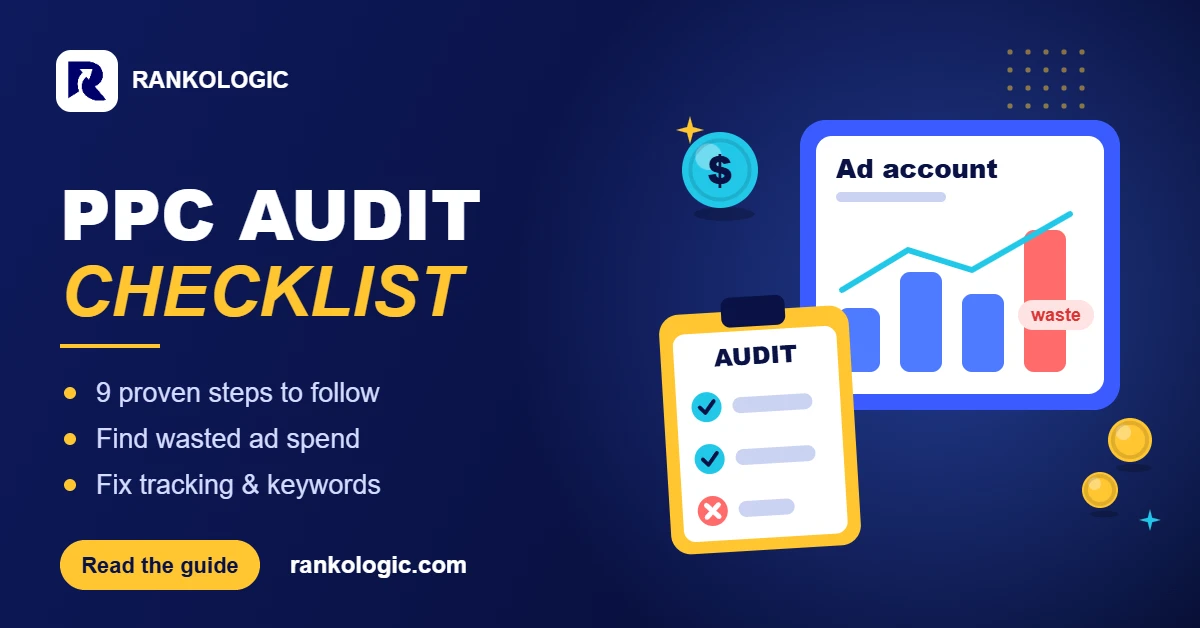
A ppc audit is a structured review of your paid search account that shows where money is being wasted and where results can improve. Over time, accounts drift: new keywords are added without a plan, search terms that never convert keep spending, budgets stay with the wrong campaigns and conversion tracking quietly breaks. This guide gives you an easy, step-by-step ppc audit checklist you can run yourself, along with the metrics to check and the problems that show up most often.
If you would rather have specialists run the review and fix what it finds, see our PPC management service or read about the benefits of PPC management.
Table of Contents
What Is a PPC Audit?
A ppc audit is a detailed health check of a pay-per-click account, most often in Google Ads. It looks at tracking, account structure, keywords, search terms, ads, bids, budgets, landing pages and targeting, then turns what it finds into a prioritized list of fixes. The goal is simple: spend less on clicks that do not help and put more behind the ones that do.
Why You Need a PPC Audit
Even a well-built account changes as you add campaigns, test ads and adjust budgets. A regular ppc audit helps you:
- Find wasted spend: irrelevant search terms, weak keywords and campaigns that never convert.
- Trust your data: broken or duplicate conversion tracking makes every other number unreliable.
- Improve relevance: tighter keywords, ads and landing pages usually lead to better Quality Scores and lower costs per click.
- Spot missed opportunities: well-performing campaigns that are limited by budget or targeting.
- Get a clear action plan: a ranked list of changes, from quick wins to longer projects.
When to Run a PPC Audit
The best time for a ppc audit is before problems get expensive. Run one when:
- You take over an account from another person or agency.
- Cost per acquisition rises or conversions drop without a clear reason.
- You plan to increase the budget and want to be sure it will be spent well.
- Your website, offer or pricing has changed.
- It has been three to six months since the last full review.
A light check of spend and conversions every month, with a full ppc audit every quarter or twice a year, works well for most accounts.
PPC Audit Checklist: 9 Steps to Follow
Work through the steps in this order. Early steps, such as tracking, affect how you judge everything that comes after them.
1. Check Conversion Tracking and Analytics
Start here, because every decision depends on accurate conversion data. Confirm that each important action, such as a form submission, call or purchase, is tracked once and only once. Check that Google Ads and Google Analytics agree reasonably well, that conversion values are correct and that the tracking still fires after any recent website changes.
2. Review Account and Campaign Structure
A clear structure makes the account easier to manage and optimize. Look for campaigns that mix unrelated products or services, ad groups with too many unrelated keywords and campaigns that compete against each other for the same searches. Group keywords by theme so ads and landing pages can match what people are searching for.
3. Audit Keywords and Match Types
Sort keywords by spend and conversions. Pause terms that cost money without results and look for strong terms that deserve more budget. Review match types as well. Broad match can find new searches but needs close monitoring, while exact and phrase match give you more control over who sees your ads.
4. Clean Up Search Terms and Negative Keywords
The search terms report shows what people actually typed before clicking your ad. Add irrelevant terms as negative keywords so they stop spending, for example job seekers, free-resource hunters or unrelated products. This step alone often removes a noticeable share of wasted spend, and it should be repeated regularly.
5. Review Ad Copy and Assets
Check that each ad group has several strong ads that include the main keyword and a clear benefit. Make sure you use relevant assets, such as sitelinks, callouts and structured snippets, and that headlines and descriptions are tested against each other. Look for ads with a low click-through rate and rewrite them.
6. Check Bidding Strategy and Budgets
Confirm that the bidding strategy matches the campaign goal, whether that is conversions, conversion value or visibility. Check for campaigns that run out of budget early in the day while weaker campaigns have money left over. Move budget towards the campaigns with the best cost per acquisition or return on ad spend.
7. Analyze Landing Pages
A great ad cannot fix a weak landing page. Check that each page matches the ad message, loads quickly on mobile, has a clear call to action and makes it easy to contact you or buy. Compare conversion rates between pages and fix the ones that bring in clicks but few enquiries.
8. Review Audiences, Locations, Devices and Schedules
Break results down by location, device, time of day and audience. You may find that mobile users convert at a very different rate from desktop users, or that certain regions waste budget. Adjust bids, exclude poor segments and add audience lists where they help.
9. Benchmark Results and Build an Action Plan
Finish the ppc audit by comparing your results against your own past performance and your goals. Turn every finding into an action, then rank the actions by impact and effort. Fix tracking issues first, then wasted spend, then testing and growth ideas.
Key Metrics to Check in a PPC Audit
- Click-through rate (CTR): shows how relevant your ads are to searchers.
- Cost per click (CPC): what you pay for each visit.
- Conversion rate: the share of clicks that become leads or sales.
- Cost per acquisition (CPA): what each lead or sale costs.
- Return on ad spend (ROAS): revenue earned for every unit of spend.
- Quality Score: a diagnostic for keyword, ad and landing page relevance.
- Impression share: how often your ads appear compared with how often they could.
Common Problems a PPC Audit Finds
- Conversions counted twice or not tracked at all.
- Keywords with high spend and no conversions.
- Missing negative keywords, so irrelevant searches trigger ads.
- Ads that never changed since the campaign launched.
- Budgets spread evenly instead of towards the best campaigns.
- Landing pages that do not match the ad or load slowly.
- Location or device settings that include audiences you do not serve.
Tools That Make a PPC Audit Easier
You do not need expensive software to run a useful ppc audit. These tools cover most of the work:
- Google Ads reports: search terms, change history and segment reports for device, location and time.
- Google Analytics: to compare ad traffic with on-site behavior and goals.
- Google Tag Assistant: to check that tags and conversion events fire correctly.
- Spreadsheets: to sort, filter and rank keywords and search terms by cost and results.
The Google Ads Help Center explains each report in detail if you need a refresher.
Get Expert Help With Your PPC Audit
A ppc audit takes time, and acting on the findings takes even more. If you want an experienced team to do both, our PPC management service covers keyword targeting, landing page optimization, A/B testing and clear monthly reporting. To discuss your account, get in touch with Rankologic and tell us about your goals and budget.
FAQs About PPC Audit
How long does a ppc audit take?
A small account can be reviewed in a few hours. Larger accounts with many campaigns, markets or products can take several days, especially if tracking needs to be fixed first.
How often should I run a ppc audit?
Check spend and conversions monthly and run a full ppc audit every quarter. Smaller accounts with stable results can manage twice a year, while fast-changing accounts may need more frequent reviews.
Can I do a ppc audit myself?
Yes. If you have access to Google Ads and Google Analytics, you can follow the nine steps above. An outside specialist can still help because they bring benchmarks from other accounts and spot issues that are easy to miss in your own.
What is the first thing to check in a ppc audit?
Conversion tracking. If conversions are missing, duplicated or wrongly valued, every performance number you rely on will be misleading.
Final Thoughts on PPC Audit
A regular ppc audit is one of the simplest ways to protect your ad budget. Check your tracking first, clean up keywords and search terms, improve ads and landing pages and then act on a ranked list of fixes. Repeat the process every quarter and your account will stay efficient as it grows.